
Writing
A Vision for Great Writers at St. Mary and St. Joseph’s
1. A Love for Writing
We want our children to:
- Enjoy writing for different purposes and audiences.
- Feel excited to express their ideas through stories, poems, and factual writing.
- See themselves as authors with a unique voice.
2. Strong Writing Skills
We aim for our students to:
- Write fluently with well-structured sentences and paragraphs.
- Use a wide range of vocabulary and grammar accurately.
- Apply spelling, punctuation, and grammar rules confidently.
3. Creativity and Expression
Our children will:
- Develop imagination through storytelling and poetry.
- Use descriptive language to bring their writing to life.
- Experiment with different writing styles and genres.
4. Writing for a Purpose
We will ensure students:
- Write in different formats (letters, reports, narratives, explanations).
- Understand how writing is used in real life (newspapers, blogs, speeches).
- Communicate ideas clearly and persuasively.
How We Will Achieve This
✅ Daily Writing Opportunities – Encouraging writing across all subjects, not just in English.
✅ Exciting Writing Prompts – Using engaging texts, topics, real-world themes, and creative challenges.
✅ Reading to Inspire Writing – Exposing students to high-quality literature to develop their style.
✅ Peer and Teacher Feedback – Creating a positive environment for editing and improving work.
✅ Showcasing Student Writing – Celebrating achievements through school displays, books, and competitions.
✅ Technology Integration – Using digital tools to make writing fun and interactive.
Intent, Implementation and Impact Statement
Our Writing Curriculum
At St Mary and St Joseph's, we have planned our writing curriculum around the texts set out in Literacy Count’s Ready Steady Write units of work. They have been designed by Literacy Counts as a scaffold and a guide for teachers to provide high-quality teaching of writing through high-quality literature. These detailed units centre on engaging, vocabulary-rich texts, with a wealth of writing opportunities within and across the curriculum and also signpost wider curriculum enrichments.
Each unit consists of:
- Clear sequential Episodes of Learning
- Model Texts linked to writing outcomes within the unit
- Vocabulary learning and contextualised spelling, grammar and punctuation
- Wider reading for the wider curriculum
- Curriculum Enrichments
- Explicit links to the national curriculum
Units of Work
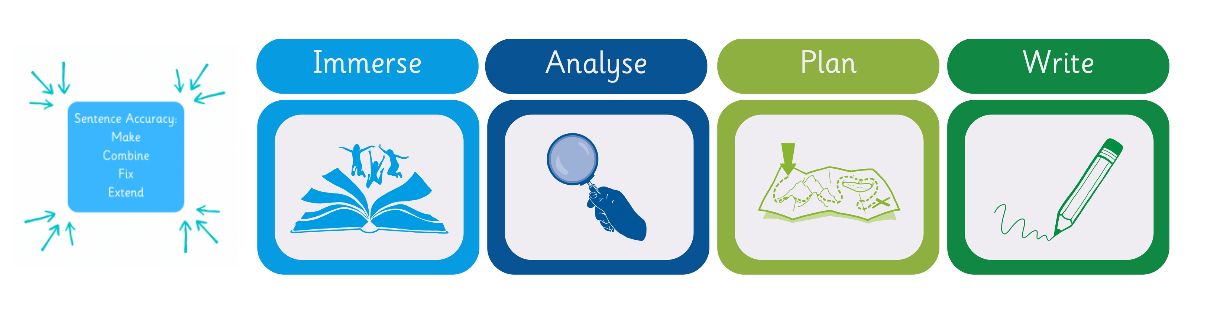
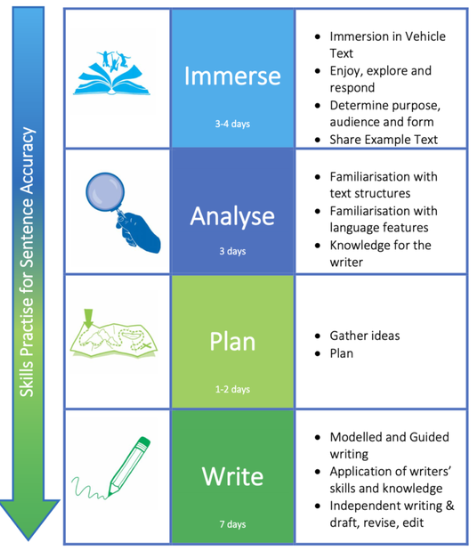
Units of work are made up of ‘episodes of learning’.
Vehicle and Model Texts
Each unit of work consists of a fiction and non-fiction writing outcome based on one high-quality children’s book. This is known as the ‘vehicle text’. From this vehicle text, a model text has been written for each of the genres to be taught so that children can study the writing skills and vocabulary used. Crucially, the skills and vocabulary choice can then be analysed for their effect on the reader. The model text is written to incorporate language features and vocabulary for that particular year group and is pitched just above greater depth in order to provide a sufficiently high model of expectations for all pupils.
Progression Overview
Please use the links below to view the progression units for Read to Write throughout school.
Ready Steady Write Progression Overview
End of year expectations
Each year group in the school has a set of End of Year Expectations in writing. It is hoped that children will achieve these expectations and even move go on to achieve some of those included in the following year group. Click on the links below to view the expectations for your child's year group.
End of Year Expectations
Handwriting
Handwriting
At St Mary and St Joseph's RC Primary School, we use Ready Steady Handwriting to help children develop confident, fluent and legible handwriting skills.
The scheme provides a clear, consistent approach to handwriting from the early years through to Key Stage 2. Children are taught correct letter formation and pencil control before progressing towards joining letters and developing a fluent, joined handwriting style.
Through regular, short and purposeful practice, children develop the fine-motor skills, letter formation and handwriting habits they need to write comfortably and confidently. Lessons are carefully structured so that children can build on previously taught skills and develop increasing independence.
We recognise that every child develops at their own pace. Our approach provides opportunities for children to practise and refine their handwriting skills while celebrating progress and encouraging pride in their written work.
Our aim is simple: to help every child develop handwriting that is fluent, legible and confident, so that handwriting supports rather than limits their ability to express their ideas.
Spelling
Our spelling curriculum is designed to provide a broad and balanced education that meets the needs of all children. We follow the award-recognised Ready Steady Spell by Literacy Counts to ensure that all pupils become fluent, accurate spellers. Our spelling curriculum is research-informed and impact-proven, helping children secure the essential skills and strategies they need to spell confidently across the curriculum. Through engaging activities, consistent teaching routines and regular opportunities to revisit prior learning, we help children move spelling knowledge into their long-term memory. Our aim is to build confident writers who are equipped with the tools they need to communicate clearly and effectively.
Spelling is taught in a clear and systematic way, with regular reviews and assessments. Additional support is provided through Ready Steady Spell: Go sessions, which offer targeted intervention for pupils who need further consolidation.
Celebrating Writing at SMSJ
Writing News
There are no items in this News Category