
Attendance
At St Mary and St Joseph’s RC Primary School, our vision is that we become the best for God that we can be, in all we do, whilst demonstrating Catholic values which are pertinent to all faiths. This policy aims to show our commitment to meeting our obligations in regards to school attendance, including those laid out by the Department for Education (DFE) statutory guidance on Working together to Improve attendance.
St Mary and St Joseph’s RC Primary School seeks to ensure that all its pupils receive their entitlement of a full-time education in order for each pupil to achieve their true potential. We recognise that poor attendance can result in lower attainment, and can impact on the personal, social and emotional development of pupils. Therefore, we strive to provide a welcoming and caring environment in which each member of the school community feels wanted and safe. Staff at St Mary and St Joseph’s will work alongside family members, and their children, to ensure that pupils at our school want to come to school every day and on time.
SMSJ Aims
- Through our whole school culture and ethos that values good attendance, including: Setting high expectations for the attendance and punctuality of all pupils
- Developing a whole school culture and ethos with regard to promoting good attendance and punctuality
- Reducing absence, including persistent and severe absence
- Ensuring every pupil has access to the full-time education to which they are entitled
- Acting early to address patterns of absence
- Building strong relationships with families to ensure pupils have the support in place to attend school.
Government Expectations
The government expects Schools and local authorities to;
- Promote good attendance and reduce absence, including persistent absence;
- Ensure every pupil has access to full-time education to which they are entitled; and, act early to address patterns of absence.
- Parents to perform their legal duty by ensuring their children of compulsory school age who are registered at school attend regularly.
- All pupils to be punctual to their lessons.
Why is Good Attendance Important?
While the Department for Education expects a minimum national attendance rate of 96% school is committed to a higher aspirational target to ensure every pupil truly thrives and reaches their full potential.
Regular attendance at school helps children to achieve their personal, social and educational potential and to lead successful lives as adults.
Coming to school every day is the best way for your child to make great friends and reach their full potential, and we are committed to making that happen for every one of our children. We want every child to feel safe, happy, and connected so they can learn and grow into confident, thriving adults.
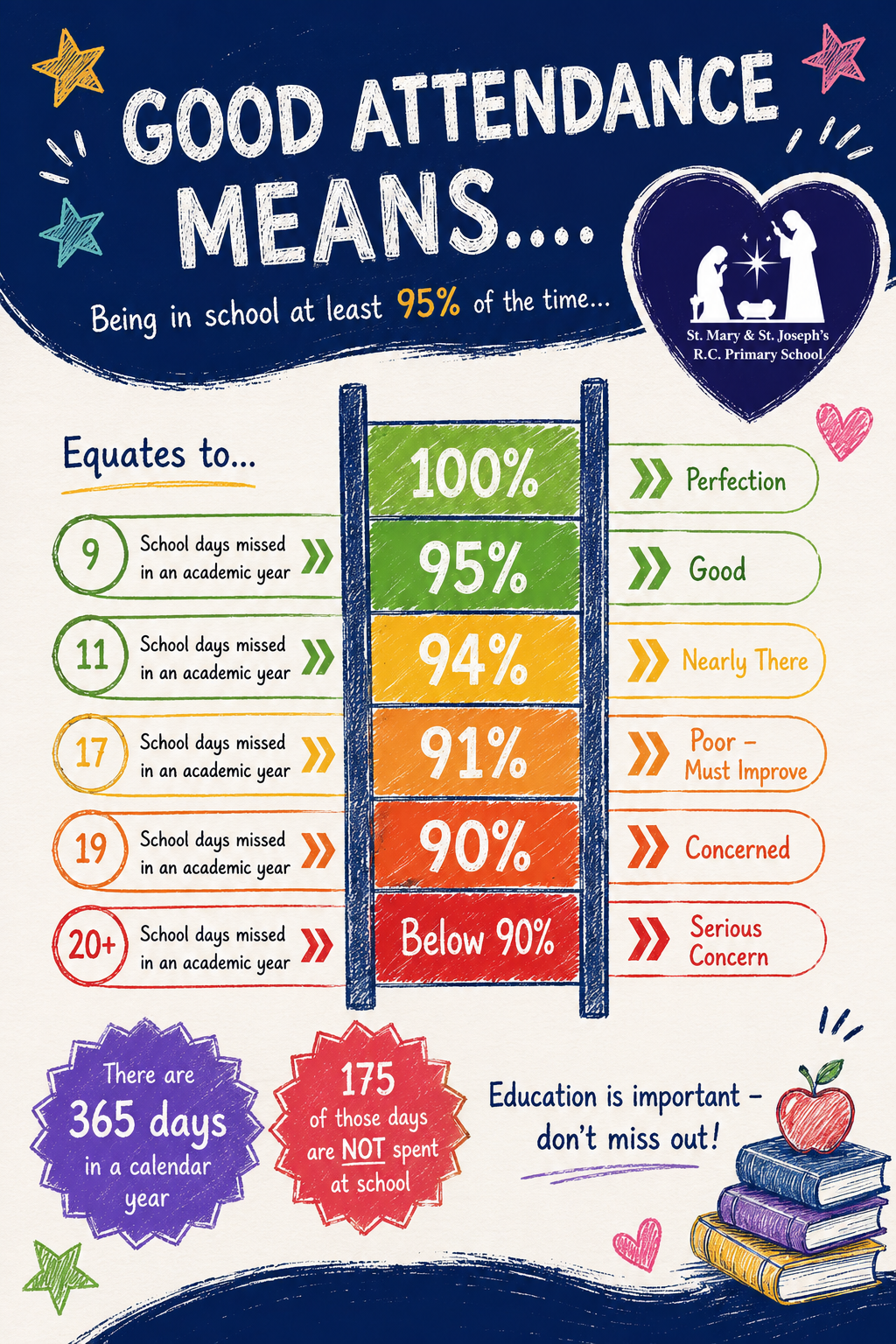
Regular attendance has a significant impact on:
- Academic Achievement: Regular attendance directly correlates with academic success. Children who attend school consistently are more likely to keep up with the curriculum, perform better in exams, and improve their life outcomes.
- Knowledge Acquisition: School is where children acquire knowledge and skills that are crucial for their personal and professional growth. Missing days means missing out on valuable learning opportunities.
- Social Development: School provides a vital social environment for children to interact with peers, develop friendships, and learn essential social skills. Consistent attendance ensures children remain connected to their peer group.
- Building Routine: School attendance establishes a structured routine in children’s lives, teaching them time management and responsibility, which are valuable life skills.
- Teacher Interaction: Regular attendance allows for meaningful teacher-child interactions. Teachers can provide personalised support, address questions, and assess individual progress more effectively when children attend regularly.
- Preventing Knowledge Gaps: Frequent absences can lead to significant knowledge gaps, making it challenging for children to catch up with missed lessons, potentially resulting in long-term academic struggles.
- School Engagement: Children who attend school regularly are more likely to engage in extracurricular activities, sports, and other enriching experiences that contribute to their overall development.
- Legal and Parental Responsibility: Parents or guardians are legally responsible for ensuring their child's regular school attendance. Failing to do so can lead to legal consequences.
- Community Well-being: High levels of school attendance contribute to the overall well-being of communities.
How to inform school of an unplanned absence
We understand that at times, your child may be unwell and unable to attend school.
Please inform school with a telephone call by 8.40 on 01254 698301, you can leave an answer phone message.
If your child is unwell for more than one day, you must contact school each morning.
If you do not contact school, this will be recorded as an 'unauthorised absence' a reminder message will be sent, asking for you to contact school with a reason for the absence.
If there isn't a reply to the message, a telephone call will be made.
If we have not heard from you by 10.30am, a home visit will be made.
Medical Appointment
We advise that medical appointments are made outside of school hours. When this cannot be done, you must bring an appointment letter or card into school. If no evidence is provided, the absence will be recorded as unauthorised. Due to legislation, if your child needs to be collected early for an appointment, school still needs to see evidence of medical appointments.
Punctuality
At SMSJ, we open the school gates at 8.45. Children are welcomed into school by the Head Teacher & other pastoral staff. When they go to class, there is toast available.
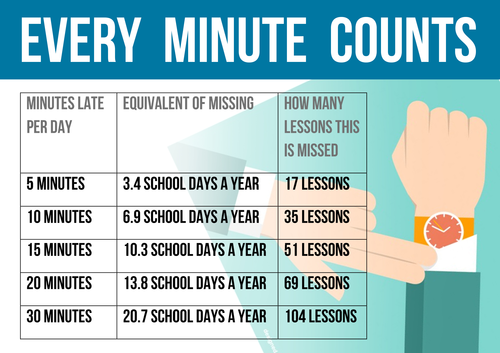
Registration is taken at 8.55am. Any child who arrives after this time, will be marked as 'late'.
Children's punctuality is carefully monitored. Children who are regularly late into school will be contacted by the office and support will be offered to improve this.
How we support you
To ensure that your children are given the best opportunities to succeed, we offer a range of support.
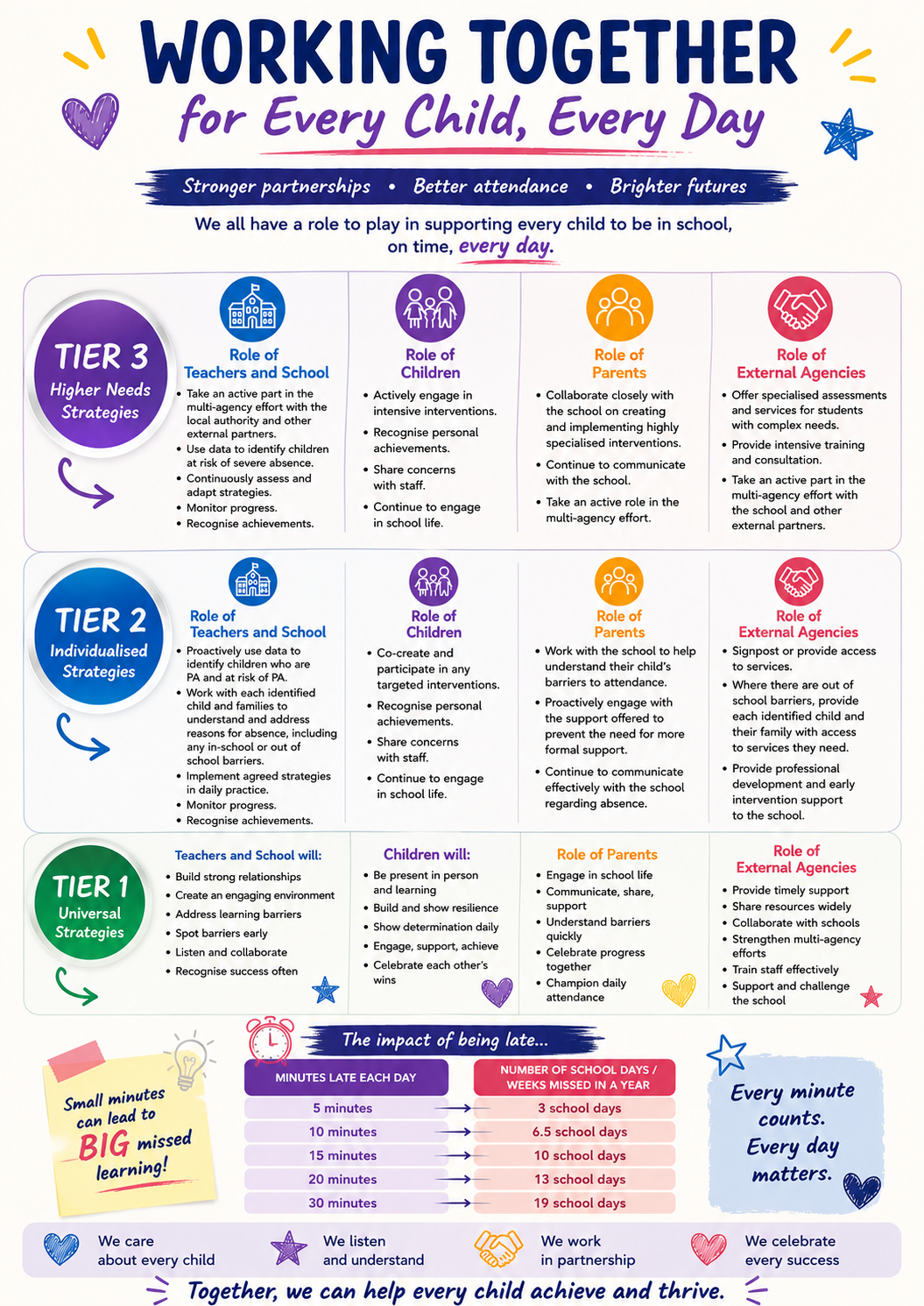
We use a multi-tiered approach to provide the correct level of attendance intervention needed for your family. Parents, children and staff in school have a role to play in good attendance. Please have a look at the guide below which identifies the level of support offered. The system aligns with the Department for Education's (DFE) "Working Together to Improve School Attendance" statutory paper 2024.
Inclusion and Penalties
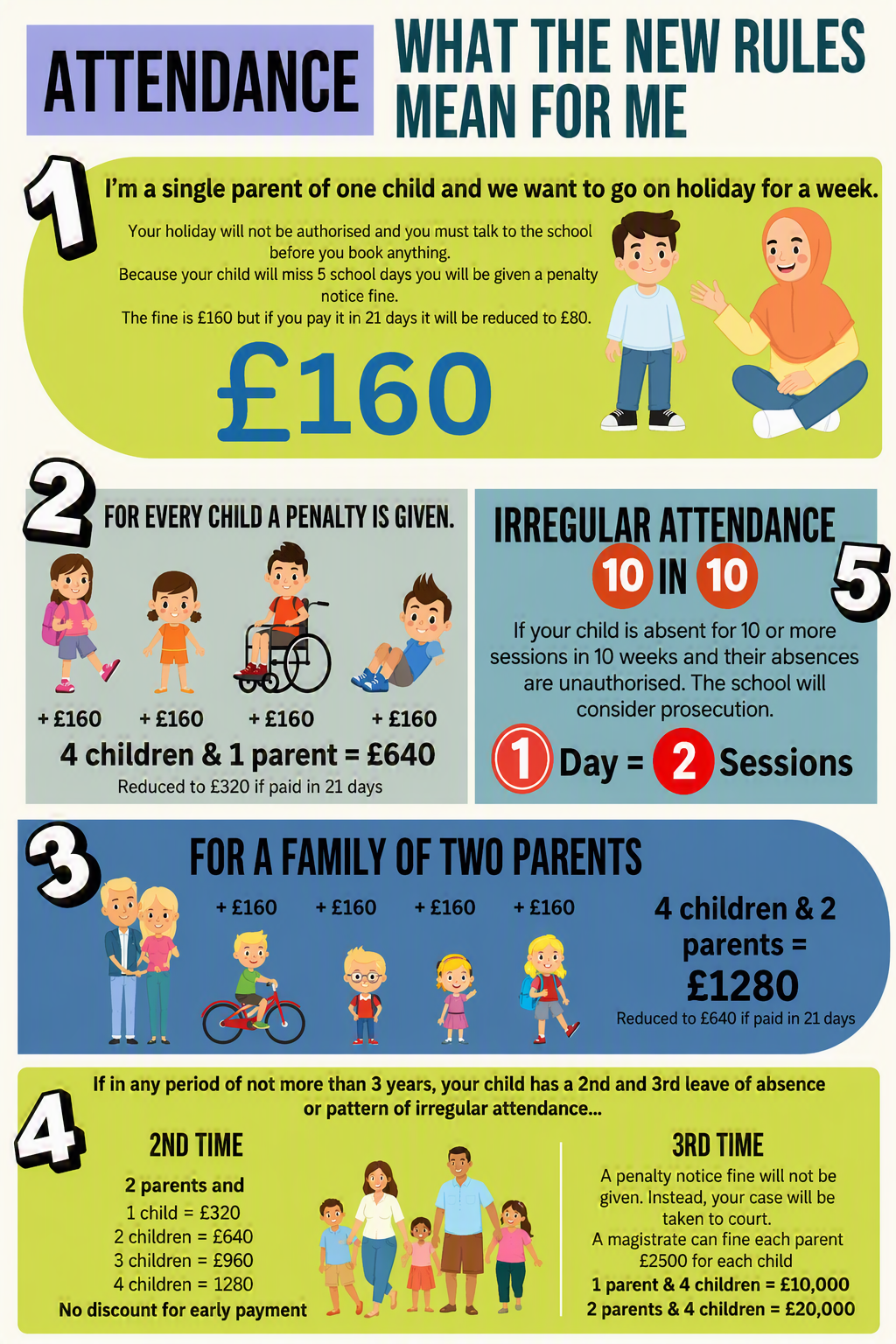
The inclusion team are referred to if there are concerns about attendance, when support has been offered or implemented, and there has been no improvement. The threshold for a penalty notice must be considered at 10 sessions (equivalent to 5 days) of unauthorised absence over a 10 week rolling period. This may also include absences as a result of arriving late after registration closes.
Holidays are not authorised for absences.
Penalty notices will be charged at £160 per parent/per child to be paid within 28 days. If paid within 21 days this is reduced to £80.
If a second penalty notice is issued to the same child within a rolling 3 year period, parents will be issued the rate of £160
A maximum of 2 penalty notices may be issued to a parent for the same child within a rolling 3-year period, so at the 3rd (or subsequent) offence(s) another course of action will need to be considered by the local authority (such as prosecution or one of the other attendance legal interventions).
Attendance and Absence Policy
Please see below our Attendance and Absence Policy for St Mary and St Joseph's RC Primary School. We believe to facilitate teaching and learning, good attendance is essential. Pupils cannot achieve their full potential if they do not regularly attend school. Missing out on lessons leaves children vulnerable to falling behind. Children with poor attendance tend to achieve less in both primary and secondary school.